
Dead Letter Department #145

a short history of desks
The first one I remember was when we lived in California, in the little Eichler house with the wisteria over the back patio and the big red heated tiles in the kitchen. It wasn’t a desk, of course: it was a vanity, painted in bright colors, with a big mirror and lots of drawers, but I did keep my journals there, which I still have, lined & spiral bound, fat with swim meet ribbons and ticket stubs and the scrawly loose little kid handwriting I had before it shifted into something more deliberate. More like my father’s. The next one, in the refinished attic room in Connecticut, must have been scooped up by my parents in some used furniture store, big and square and wooden with a slanted top that lifted up, though at that age I probably spent more time scratching away in bed, or on the floor. There were the heavy wooden slab-top desks at middle school and high school too, of course, with multiple generations of carved or sharpied graffiti, but those were no good for writing, because they were at school.
I can remember a lot about the rooms at boarding school, down to the big, solid, last-through-five-generations-of-teens twin beds, but not the desks, and though I have a pretty perfect memory-picture of the apartment above the Quaker meeting house I lived in my last year of high school, including the long blue built-in cabinets across one wall, I don’t remember working at the countertop there. The downtown coffee shop or my friends’ parents’ living rooms, yes, or the coatroom while J played his guitar, with all the different kinds of notebooks I was trying on for size: huge sketch pads that were unwieldy to haul around, and little graph-paper notebooks to force me to write small & neat, composition books stacked up with school notes. I think this is about when I started to take it seriously as a practice, keeping a notebook, keeping track of my reading.
At Antioch, my roommate fell in love almost immediately upon her arrival to campus, decamping to her boyfriend’s single and leaving our square white cinderblock room and side-by-side built-ins mostly to me, though I spent more time in the decaying library, where whole swathes of the collections had been stolen, and then the rather horrible little off-campus room where I lived out my last semester, constantly getting scolded by the landlady for going over the ten minute limit on the shared phone. The desk there was good and the room was quiet, but I was frantically unhappy, feeling along the seams of my decisions to find the escape hatch.
The rooms at Bennington were perfect, once I got out of the new dorms and into a single in the old ones: a futon on the floor, creaky wooden floors, views out to the woods at the End of the World, and the old wooden desk with my heavy-ass laptop and stacks and stacks of books for courses, one wall always covered with the taped-up, sprawling collage I hauled from place to place of postcards and magazine photographs and polaroids of my friends. In some ways I think this is still my set-point working space: a utilitarian room with white walls, a view of some kind, a mass of changing images to futz around with, friends knocking on the door to go to dinner together.
There were also the library carrels, with the antiseptic smell of the floor cleaner, though I never went so far as to reserve one for my own especial use, the Upstairs Cafe, the practice studio in the haunted music building my flute professor let her students use after hours, though that was good more for privacy and thinking about ghosts, and finally the half-a-dozen work areas where I met with little writing groups, including the four students who got together with an overseeing teacher one semester to do something where we wrote every day—probably one of the more practically useful writing skills, though it took many years for it to come back, once I was out of the arts hothouse of college.
Then it was years of a square green fold-out card table, the exact one my mom now uses to do her puzzles on, because I was moving into and out of various apartments, first with C in Northampton, while I tried to convince myself that I could live there, settle into the very specific kind of queer community happening in that place, keep my other east coast friends in reaching distance. The table came along with me in the back of my Toyota Echo all the way across the country, along with all the boxes of books and two house plants, landing in the little nook in the falling down cabin outside of La Connor where I started to really write again after what felt like a long, lacerating attempt to give it up after college as a bad job. It came along to the next place too, the table and the writing and the futon, and it occurs to me now what an excellent little workhorse it’s been all these years—so plain and portable, uncomplaining: one tear at the corner, mended with duct tape, and otherwise as sturdy as its ever been.
When I wanted more space to work at the next place, I got two shabby filing cabinets and a door to sling across them in the second bedroom, determined to finally give myself some space to spread out, but then I barely used the room because I was constantly having people come to stay, sometimes for long periods of time, until finally one night I was awakened by the drunk college kids bouncing on a trampoline and shooting a potato gun, and I realized I was simply too old to live in the neighborhood anymore.
Here, now my longest residence by double digits of years, I’ve decided that I’ve permanently solved the problem of what to work on any number of times, starting off with a tiny yellow console table with almost zero footprint, just wide enough for a laptop and a little lamp, thinking that would somehow keep me uncharacteristically minimalist & focused, and then a badly assembled Ikea desk that almost immediately developed pockmarks and cracks in the shitty MDF top, and also rattled when not braced exactly the right way if I typed too vigorously. I tried another little table, but this one had an unpleasantly textured top that meant I had to put a sort of blotter over it to write on thin paper, and ended up in my mom’s studio for her to sketch on when I booted it out of my apartment in frustration.
I’m back to a slab of wood now, one that’s unfinished & not quite large enough, braced on two mismatched bookshelves that are full of desk supplies & the ever-growing to-read pile, and I’m sick of it. It feels unsteady, fundamentally, and I worry if I knock it the wrong way my laptop will end a casualty, so I’ve been shopping around.
I had a fantasy about using the old butcher block tabletop because it’s still beautiful, and wrapping the look of the butcher blocks on the kitchen counters around that side of the room would look lovely. My fridge needs to be replaced, and I actually looked into getting a slimmer model to make enough room, but it turns out the interior cubic square footage goes down drastically, too drastically for the amount of produce I like to keep on hand, once you get under 28” wide.
What I want is: actual wood, with a smooth writing surface, desk-deep but long enough to fill the entire wall so I can leave research books & half written letters out instead of scooping them all into an incoherent pile. A drawer or two wouldn’t go amiss, but isn’t required. It also needs to feel right, pleasing in a way that is difficult to articulate, because I will literally be touching it for hours every day.
Of course what this actually means is I have whale tastes on a mouse budget, so I’ve been to every place that sells used furniture that I can think of with no success.
New seems out of the question—all the retail places are either outrageously expensive or sourcing from the same terrible monolith manufacturers. There seems to be no middle anymore. This is one facet of enshittification, yes? The upper edge still exists—the truly fancy home stores, even the actual master furniture makers—and the lower, but the middle is nearly wiped out, and what’s left isn’t here in town anyway; it’s online. You can’t really tell how a desk is going to feel under your hand by spinning the little picture around in the 360 visualizer on your phone.
There used to be a place in town that sold only furniture made of real wood, and I wish very much it was still open—my favorite bookcases are from there—because trying to even figure out what’s made of real wood versus the thinnest possible veneer over what is essentially thick cardboard is nearly impossible with just a description. If I could see a desk in person, knew it was made properly and would last, for that I think I'd save up properly, the way I did for the shelves, plan to keep it for a long time, but the store is long gone.
I’ve been to the Restore like four times this month, just wandering around trying to get creative. Could I use a slab of finished countertop, if it happened to be exactly the right size? Would my questionable skills stretch as far as replacing a missing leg on a table that might be the right size? I keep thinking I can find something that means I won’t have to think about this again, because I’m to the point of problem-solving where I’m getting sick of myself.
But the thing is, of course, you can’t actually solve a room. Not for good, not permanently, not if it’s going to be a place that’s alive. I’m sure you’ve been in calcified houses too, where the art isn’t looked at and the tchotchkes aren’t touched, and I’m not really talking about the kind of formal places where that’s how they’re meant to function: untouchable and behind a velvet rope, even if the rope is just in your mind. I mean rooms that don’t have any air in them, no movement, no shifting habits that shift the space.
This month I need stacks of reference materials and leg room for wiggling around; next month I’ll need a completely clear field & a place to put tarot cards. Sometimes I like the sensation of impermanence, of makeshift furniture; others it makes me feel like I’m not taking myself seriously and I need something that feels intentional, can’t be disassembled and packed away in five minutes, and every time it switches I think it’s switched for good. Some of this is the sort of nearly-productive procrastination that so appeals when the work itself is not quite in reach, and I know it, but some of it is useful ritual.
So for the time being, in the course of writing to you, I’ve solved the problem cheaply online, with something that can be folded up and put away when I start to violently despise it and probably trotted back out again at a later date as the winds shift. I’ll report back how it goes, once I’ve broken it in a bit, and in the meantime, if you have a perfect writing surface of your own, tell me about it at departmentofdeadletters@gmail.com
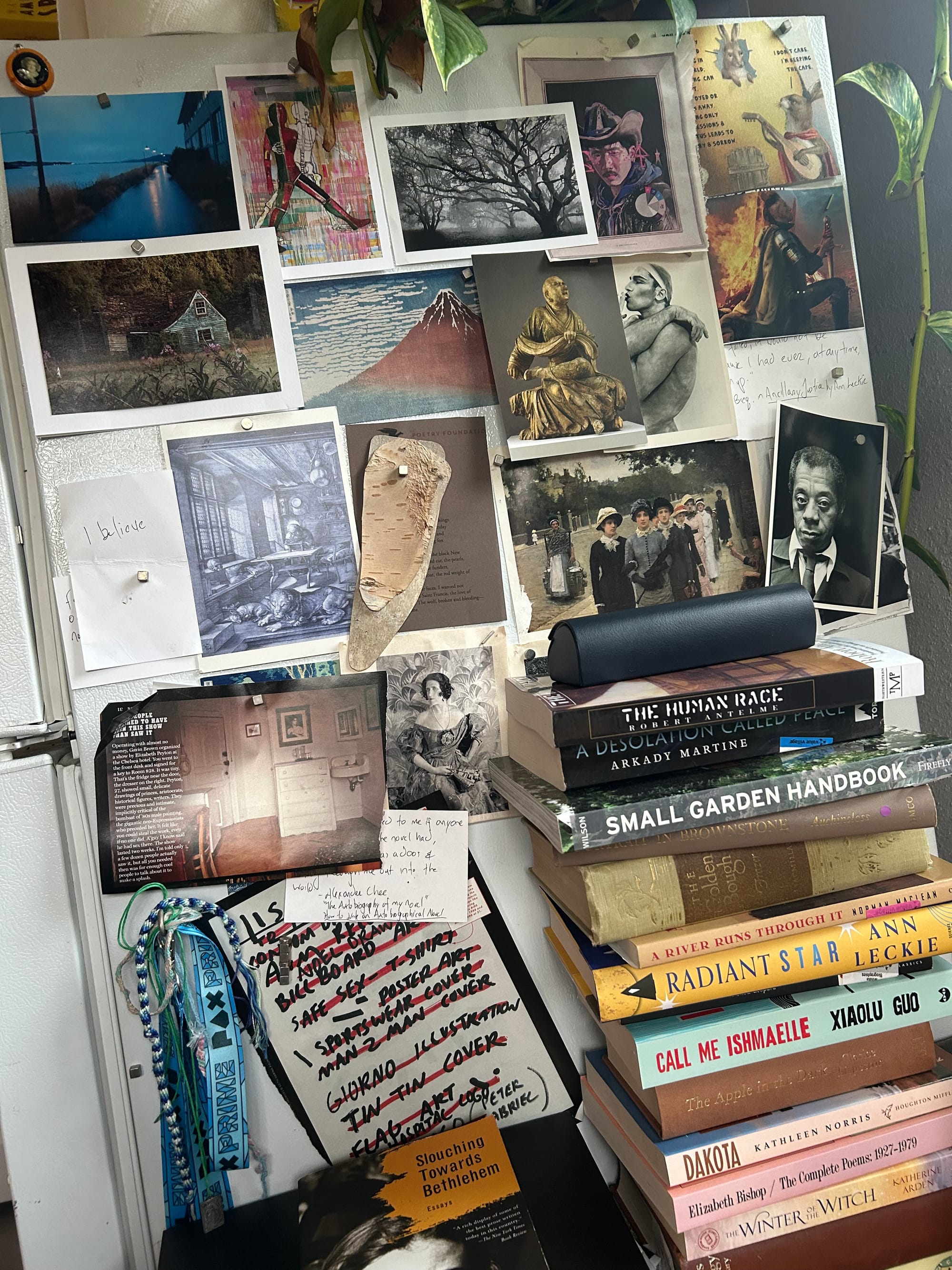
(Recent honorable desk mentions go to J’s dining table at the rental house before she bought her current place, with the ottoman pulled up next to me so her dowager empress of a cat could keep me company, the little round table in N’s casita, the plastic picnic bench outside T & C’s cabin, the long table at the Rockaway rental with J & A where I laid out all the notecards for the novel that’s currently out on submission, and every coffee shop table where I’ve had a working date with C.)