Dead Letter Department #125
weather report
I sort of forgot about Valentine’s Day until I was suddenly in the trenches early on Saturday morning, by which I mean Trader Joe’s. The usual army of early morning grocery buyers, tending towards the efficient & swift, was engulfed by a glut of puzzled looking men, wandering among the flowers and candy, hefting items and putting them back down again, wandering from the ranunculus to the gerber daisies and back. Some of them seemed to be ticking off some sort of list, armed with multiple bouquets stuck in the child seat of their red wire cart, amassing enough love tokens for an army. Others were clearly lost. Did their particular valentine prefer milk or dark chocolate, I could see them desperately trying to remember. Were roses, gorgeous, expensive & utterly cliche, the move this year, or hadn’t there been some mention of another flower?
There were three grocery stores to go to on my morning rounds, and each presented the same comical scene: distraught expressions next to the baked goods, horrified contemplation of what is essentially surge pricing for florals.
“I just think,” one of the clerks told me, “that unless you’re in elementary school and getting valentines for the whole class or in a brand new relationship, it’s just not that big of a deal.”
That did make me wish, a little, that I had acquired a fistful of small paper envelopes & could distribute them to my particular favorites during the day, perhaps to a self-decorated box on their desk as we used to have, but barring that liquidity of time, I just bought the usual things and extracted myself from the scene to acquire coffee.
The baristas were all wearing bobbling heart headbands and the line outside the coffee stand was long, so the owner popped out to get orders from the waiting cars.
“We’re doing Galentine’s day here,” she said, when she handed me my coffee with a little handful of chocolate hearts. “We’re for the girls, all the way, because men are weird.”
“They sure are,” I said, and felt a little fizz of delight at having made myself sufficiently recognizable, in the quick interchange of a coffee regular, as a man she could say that to without thinking twice.
Outside spring has arrived, in all her trailing glory, although personally it is feeling a bit like this:
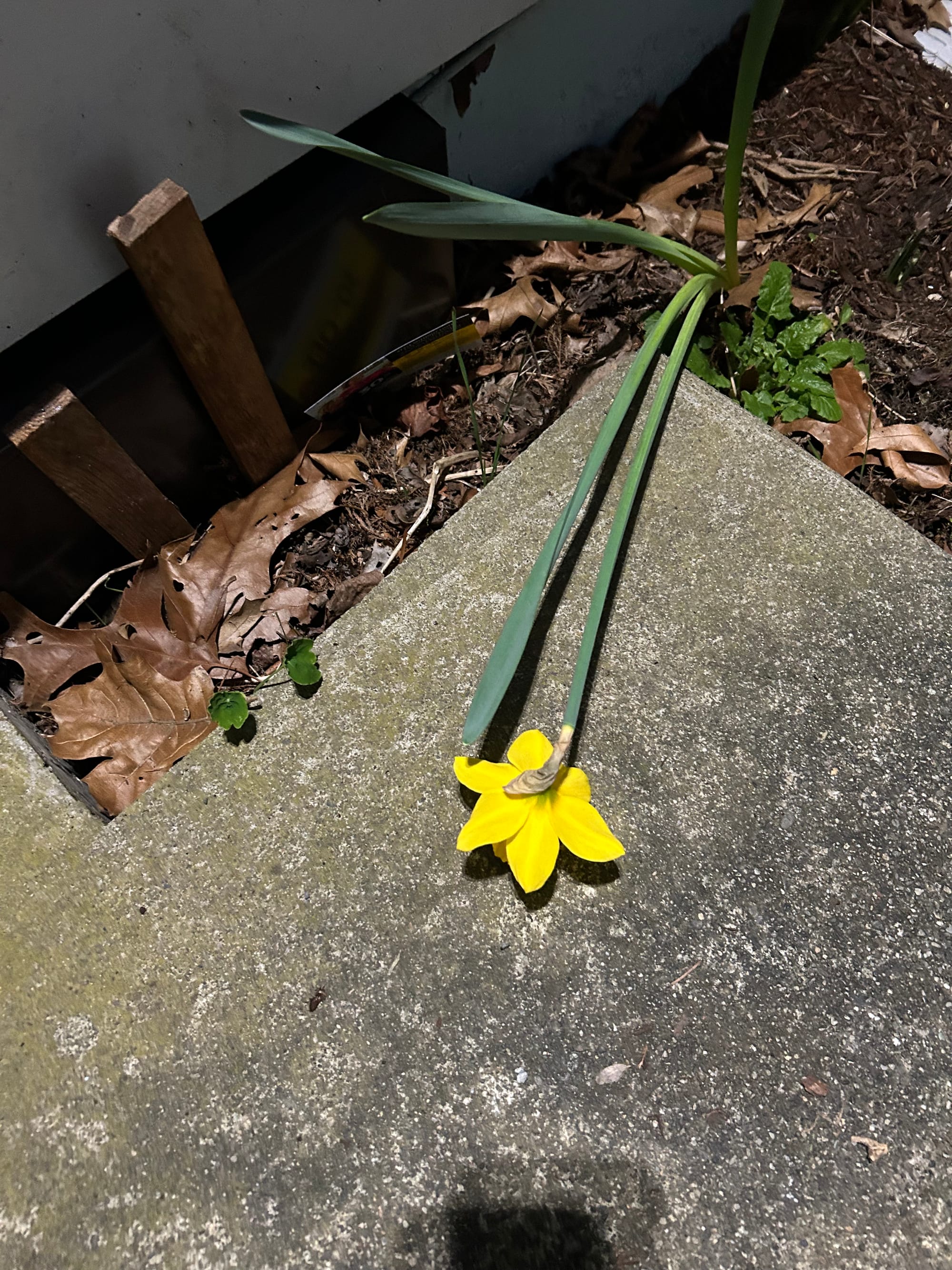
The daffodils are in full bloom, a patch of vinca under the dogwood has shy purple stars glowing in the shade, and the pink plum tree in the front set its first buds to open right as J arrived from Portland to spend a couple of days—well, a couple of nights and one day, really, but when friendship is long distance, you take what you can get.
We had a couple of must-dos: the Supergraphicultramodern cocktail at L&L and a walk by the water, and the rest was rather spur of the moment. Rose and cardamom lattes at Roam, dumplings from Pel Meni for dinner, a wander through the beautifully arranged vintage things at Irongate. When we landed back at my place and were presented with the conundrum of what to watch, I suggested Sinners.
“What’s it about?” J. asked.
“Vampires and —” I began to explain.
“I’m in.”
So we watched, and if you, like me, are late to the Sinners party, I can only say that you should turn your television on this very evening & get into it. The movie gripped me, held me absolutely captive in a way that my fractured attention span rarely allows, and I keep thinking about it since then: the music, the dancing, the love stories, and of course what or who could stand outside the door and call you out of safety to meet a terrible fate? Whose voice would be undeniable?
reading room
It took me forever but I finally finished The Grand Affair: John Singer Sargent in His World, by Paul Fisher, which seemed like the natural next step after my Isabella Stewart Gardner rabbit hole. So often biographers seem either totally high on their own supply, frantically putting blocks together to elevate a figure they think under-appreciated or misunderstood, or they swing so far into the scandals and the modern interpretations of past events that the subject fades into a paper doll plucked out context.
Fisher slices down the middle of those unsatisfying methods to do something much better. His tremendous love for the paintings makes them glow on the page, but he sets Sargent into place by illuminating the social factors that made him possible: the privilege of the colonizer, traveling to subjugated countries to collect models who remained simultaneously anonymous and exposed while the painter profited from them, as well as the ambitious artist scratching his way upward to becoming a society portrait painter and support his family.
It’s been interesting as I’ve gotten older finding out how many artists or cultural figures I felt drawn to before knowing anything about their personal life are, in fact, some flavor of queer, and Sargent is no exception: a twenty-five year relationship of some kind with his model/valet, a great pile of male nudes, unknown until after his death, that his surviving sisters very carefully placed with any museum who they could persuade to take them, just as they did with his more famous and vastly more acceptable society portraits and landscapes.
Sargent himself was intensely private, much of his correspondence with his contemporaries lost (what I would give for the letters between him and Henry James!), but Fisher doesn’t fill in the blanks with assumptions about the artist’s interior life in that way I find so annoying. He shows the work and he shows the life; polished, ambitious, addicted to painting from a very young age, and profoundly reserved.
Sargent’s studio happened to be across the street from Oscar Wilde’s home (the two knew each other, although apparently not well) when Wilde was arrested, after a tremendously scandalous court case, for ‘gross indecency,’ and imprisoned, an ordeal he never recovered from.
It was one of the first celebrity trials, splashed over the newspapers, and I keep imagining Sargent watching the horror of it unfolding right across the street from where he was, as always, painting; watching it happen as he put his male studio models into poses he would later use for society hostesses, as he drew intimate sketches of his valet reading in the bunk of the train they were taking to Venice, as he allowed another rumor about marriage to a woman of his acquaintance to surface and then eventually die, all while he clenched a cigarette in his teeth and stood at the easel.
More soon, and in the meantime, I hope your own springtime feels as though it is at least possible, if not actively on her way to you as you read this. Write anytime to departmentofdeadletters@gmail.com, and I plan to catch up with those of you who have reached out & not received a response yet soon.